
Personal Experience with Role Models
Growing up, as with most young athletic boys, my first role model was Father. He was the funniest, could do everything, was the best at everything and he knew everything. Big shoes to fill, but wanting to model myself just like him became my first life quest. Yet my Dad was complicated. He had a dark side, moody, angry, tempermental, all performed with a warm Guiness Stout in one hand and a Salem Menthol in the other. Not exactly the behavior an impressionable youth should model.
As I would learn later in life, Dad had his demons too. But as a young child, all I wanted to do in life was be like him. So kids being kids, try I did. I can laugh about this now, but by age 10, I had a beer bottle collection that took up half my room. And if that wasn’t weird enough, my Dad encouraged it, bringing back random regional beers from his various travels. Needless to say, my modeling of Dad’s obsession with beer wasn’t going to end well, and I have the rehab bills from my adulthood to prove it.
My Dad had numerous passions, chess, math, hockey, literature, but only one true love and that love was tennis and he was determined to make it mine too. A depression era kid, the opportunities to pursue his athletic dreams were never realized, but he held out hope that if he ever were to have an athletic child, he would invest everything he had in making him a professional athlete and as fate would have it, I happened to be that kid.
It was the 1970’s, the great Tennis Boom was in full swing. Learning tennis back then wasn’t easy, there were few coaches and the whole academy/junior program learning model was still years away. But if you had a parent with a love of the game who knew just enough about tennis to be dangerous, you could at least get started and that was us.
Flying blind, my Dad figured the way to play was to emulate the best players in the world and at that time, there was a brash midwest American youngster named Jimmy Connors dominating the tour. The plan was simple: Take the ball early, hit it hard flat and deep and compete like your life depended on winning and one would become pretty tough to beat. It was working for Connors, it should work for me, and that’s how Jimmy Connors became my first role model, even down to the haircut.
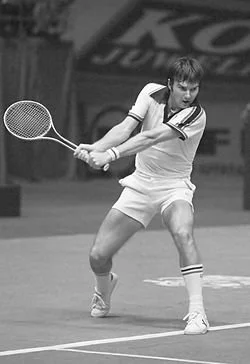
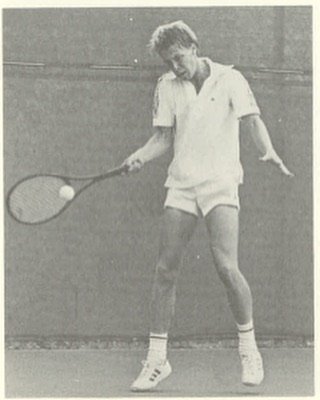
Playing style aside, whay worked for Connors as an experienced tour professional was going to take some time to refine for my developing 11 year old self. His seeming high risk high reward style was all fine and dandy in practice, but when matches got tight, not so easy. Feeling the nerves, I would revert back to my safer, pushing style of play, resulting in mixed results yet firm disapproval from my Dad. His decree was pretty straightforward; If he was to invest his scarce time in my tennis development, I had to play his way or else.
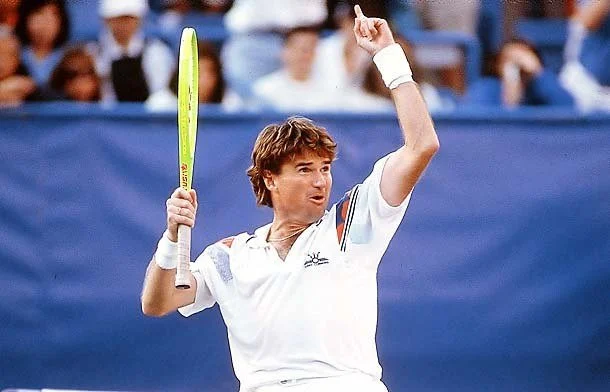
But emotionally, I simply couldn’t. My nervousness would cause my brian/body connection to short-circuit. I became petrified of losing and, even worse, how I was treated for losing. So I developed a new set of role models. With all that chaos swirling around my head, I vividly remember being in awe of the kids who could keep their emotions under control on the court. How was it possible to play freely and confidently and joyously (and quietly!) ? Were they not as crazed emotionally as myself when matches got tight? And if not, what were they doing differently than my temperamental self? I simply had to learn what they were doing differently and how it was done.
Off the court, I would watch the family dynamics of my competitive peers, so confused by how their parents supported and loved them unconditionally, win, lose, or push, for that was so not my experience. What I would have given for a support system like that. And though I was young and not entirely in sync with the full workings of the world about me, those examples were some of my first lessons in what constituted emotional intelligence and the powerful influence observing others had upon me
As an older adult, when I was in the battle for my life in the rooms of alcoholism recovery, I discovered a different kind of role model entirely. My peers there weren’t top-ranked tennis players playing for cash and prizes. They were survivors, men and women committed to the transformative process of healing themselves, who taught me that real strength didn’t lie in dominating an opponent but in surrendering to the all-powerful scourge of alcoholism. Real strength was having the courage to admit you were defeated and to finally ask for help, acts so antithetical to my hyper-competitive self-reliant tennis upbringing. My new role models in recovery showed me how to rebuild a shattered life, and I owe my existence today to these anonymous heroes.

Inspired by them, I set out to become like them. And work it did. I’ve watched countless people rebuild their lives from ashes, not because they were extraordinary, but because they were honest, humble, and willing to change. They modeled the kind of emotional self-awareness and compassion I needed to change, something that, when you’re hardwired toward intense competitiveness, I resisted to the point of insanity.
All these experiences, my upbringing, my tennis life, and my experience in the rooms of recovery, forged the foundation of my work today. Emotional intelligence isn’t a luxury in tennis or in recovery — it’s a necessity. It’s what keeps us coming back, to keep working at it til it works.
Here at FBTL, we strive to model ourselves like in the spirit of our Ideal Player. We want to approach Role models as mirrors. They don’t give us a blueprint to copy; they help us recognize traits already within us; the sparks of passion, hope, gratitude, and humility waiting to be ignited and expressed. The best role models teach us that our grandest goals in life do not end at a destination, but exist as daily practices that empower us, all the while becoming the most positive influence we can be to others
Today, through First Ball To Last, I try to carry these values forward —to be the kind of role model I once needed. My mission isn’t to tell you who to be or how to be, but to help you discover who you already are, and to equip you with emotional tools that will not just be performance-enhancing but life-enhancing, allowing us to look upon our role models, in tennis and life, with the greatest appreciation.